
Narrabri Lateral Pipeline
Narrabri Lateral Pipeline
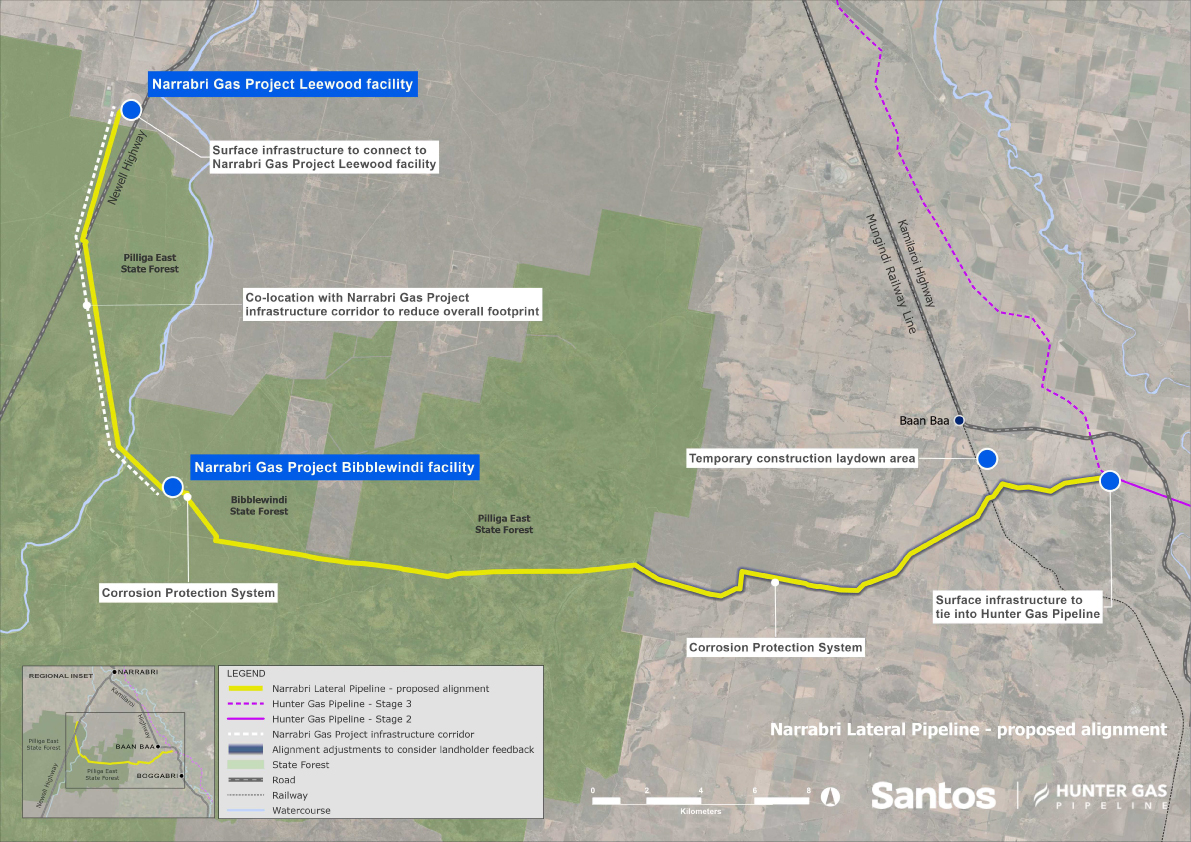
The proposed Narrabri Lateral Pipeline (NLP) will connect the Narrabri Gas Project (NGP) to the Hunter Gas Pipeline (HGP), transporting 100 per cent of Narrabri gas to the existing NSW gas transmission network. The NLP project is located in the Narrabri Shire local government area in north-west NSW within the traditional Country of the Kamilaroi (Gomeroi) People. The underground pipeline will span approximately 55 kilometres, starting at the Leewood gas processing facility (about 20 kilometres south-west of Narrabri), running south-east via the Bibblewindi facility, and tying into the approved HGP (approximately 5.5 kilometres south-east of Baan Baa). The NLP will bring economic benefits to Narrabri and surrounding regions, supporting up to 200 jobs during the peak of construction. The NLP will be buried underground with limited aboveground infrastructure.
Santos is committed to minimising impacts on communities, landholders, and the environment. We continue to consult with directly affected landholders, councils and the broader community, and we encourage people to engage with us so we can better understand their feedback and insights. The project will require approval from both the NSW and Australian Governments.
Project facts
Km in length (approximate)
months for the main construction phase (approximate)
TJs/day of Narrabri gas transported to east coast domestic market
jobs during peak of construction
| Length | Approximately 55 km |
| Material | Epoxy coated high strength steel |
| Diameter | Up to approximately 508mm |
| Minimum Depth |
Typically 750mm, depending on ground conditions and land use |
| Design Standard | AS2885 Pipelines – Gas and Liquid Petroleum |
| Easement | Nominally 30m wide |
How will the pipeline be constructed?
Watch the animations below to learn more
Pipeline construction involves a repetitive sequence of activities, which are planned, scheduled and integrated to function as a continuous production process. An overview of the key activities is provided below.
Survey and fencing
Surveyors will mark clearing limits, then temporary gates and fences will be installed where required to allow crew movement while protecting livestock and the surrounding environment. Gateways will be placed along the alignment and between properties as agreed with landholders and stakeholders.
Clear and grade
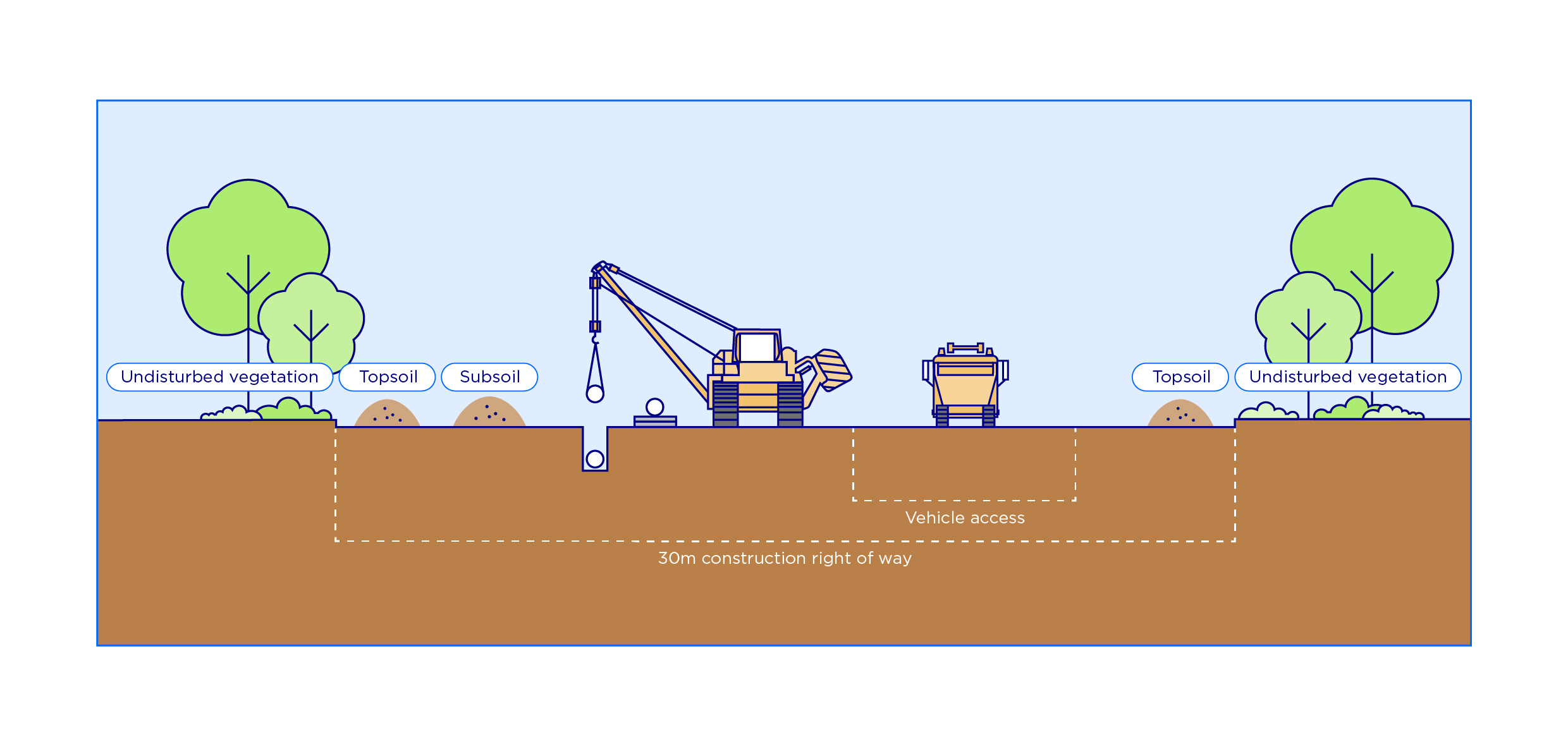
Clearing and grading will create a safe, level construction surface within a typical 30-metre right of way, adjusted where needed to protect environmental, heritage or land use values. Topsoil and vegetation will be stripped, stockpiled for site restoration or mulched for rehabilitation.
Construction would also include clearing and grading, earthworks, gravel placement where required and installation of drainage for the Baan Baa construction compound and new access track. The Baan Baa compound is the name of our facility which will be used for the storage of pipe, equipment and materials and may include temporary offices, wash bays and maintenance areas.
Pipeline installation
a. Stringing, welding and coating – the pipes are laid out along the right of way which are then lined up and welded together. Weld areas are cleaned, coated and checked for defects to ensure pipeline integrity.
b. Trenching and trenchless installation – most of the pipeline will be installed by trenching using specialised machines, with trenchless construction methods used at a number of watercourses and key road and rail infrastructure. Soils from the trench will be stockpiled separately to topsoil and used for backfilling.
c. Lowering in and backfilling – after trenching, welded pipe strings will be inspected, then lowered into the trench and joined together (tie-ins). The trench is then backfilled and compacted. Open trench lengths are minimised where possible.
d. Trenchless construction methods – trenchless construction methods are used to install pipelines where conventional open trench construction is not feasible or where disturbance to surface environmental features, land use or physical obstacles are to be avoided.
e. Hydrostatic testing – after installation, the pipeline is hydrostatically tested with pressurised water to ensure integrity.
Reinstatement and rehabilitation
a. Following installation of the pipeline, the trench would be progressively backfilled, and topsoil respread as construction progresses along the right of way. Other disturbed areas not required for operation of the project would be reinstated and rehabilitated as soon as practicable after construction is complete.
b. In agricultural areas, rehabilitation would aim to return the land to its former use in consultation with the landholder. Most normal agricultural activities, including cropping, can recommence within the easement following construction.

c. In areas with vegetation, the construction area would be allowed to naturally regenerate. A width of about 20 metres over the pipeline would be maintained to be free of trees to ensure the pipeline is not damaged by roots, and to allow ongoing access.

Environmental Planning and Assessment Act 1979 (NSW) assessment
The NLP is a Critical State Significant Infrastructure Project. Santos submitted an EIS for the project which was publicly exhibited from 20 November through to 18 December 2025.
An EIS is a document required to support the application for all major projects in NSW. It assesses the potential environmental, economic and social impacts of a proposed project and helps the community, government agencies, and decision-makers understand the project’s benefits and impacts.
The EIS is available for viewing at https://www.planningportal.nsw.gov.au/major-projects/projects/narrabri-lateral-pipeline.
Santos recently submitted a Response to Submissions report to DPHI for their consideration and assessment. This report addresses the matters raised by the community, government agencies and other stakeholders during the EIS public exhibition process. This report is available for viewing on the DPHI website: https://www.planningportal.nsw.gov.au/major-projects/projects/narrabri-lateral-pipeline
Since exhibition of the EIS, Santos has continued to refine aspects of the project as a result of further site investigations, construction planning and consultation with landholders and stakeholders. The proposed refinements to the project are minor and localised and will not change the overall scope of the project described in the EIS. They include changes to:
- site access by refining works on roads and tracks, proposing new tracks and removing some tracks that are no longer required
- the pipeline alignment and construction right of way at two locations
- the disturbance footprint, including for construction workspaces, site access and pipeline alignment changes and to incorporate habitat connectivity design features. The overall size of the disturbance footprint is expected to be reduced.
These refinements will not affect any new landholders or stakeholders compared with the exhibited project.
The proposed project refinements are being documented in a separate Amendment Report, to be submitted to DPHI for assessment in Q4 2026.
Environment Protection and Biodiversity Conservation Act 1999 (EPBC Act) assessment
In November 2024, Hunter Gas Pipeline Pty Ltd referred the NLP to the federal Department of Climate Change, Energy, the Environment and Water (DCCEEW) in accordance with the Environment Protection and Biodiversity Conservation Act 1999 (EPBC Act). In February 2025, the Australian Government determined the NLP to be a ‘controlled action’ requiring assessment and approval under the EPBC Act. The NLP will be assessed under the bilateral agreement with the NSW Government. The NLP EPBC Referral (2024/10050) decision is available on the Commonwealth EPBC Public Portal.
Santos recently submitted an application to vary the NLP EPBC Act Referral (2024/10050) under section 156A of the EPBC Act. The variation requests small changes to the proposed action area to appropriately accommodate the Project. A decision on the proposed variation to the EPBC Act Referral is pending with the Australian Government.